Thursday, October 26, 2017

El Camino de Santiago - 2017

Day 3: Cirueña to Grañon

3rd morning picture just west of Cirueña
Location in Google Maps
Michelle wrote:
09 Sept. Saturday
We had a breakfast of toast and Cola Cao (served by the hostess) and got on the road at 8:00 am. It was overcast with some light rain, but nice and cool. 


The walk was an easy 5.8 km into Santo Domingo de Calzada with fields all around.  We think they might be potato fields because we passed a potato packing plant on our way into town.  
Breakfast in Sto. Domingo.
Fresh squeezed orange juice and
Finally: REAL CHOCOLATE

We stopped for a snack and had our first real chocolate on the Camino this year.  Then we had to stop in a shop for pilgrims (Planeta Agua) and Curtis finally bought some flip flops!  It is very helpful to be able to get your feet out of boots or shoes and into sandals or flip flops at the end of a day of walking.  They can air out and spread out and relax.  

It was a nice walk 6 or 7 km walk between fields to Grañon.  The light rain was on and off and so were our ponchos.  


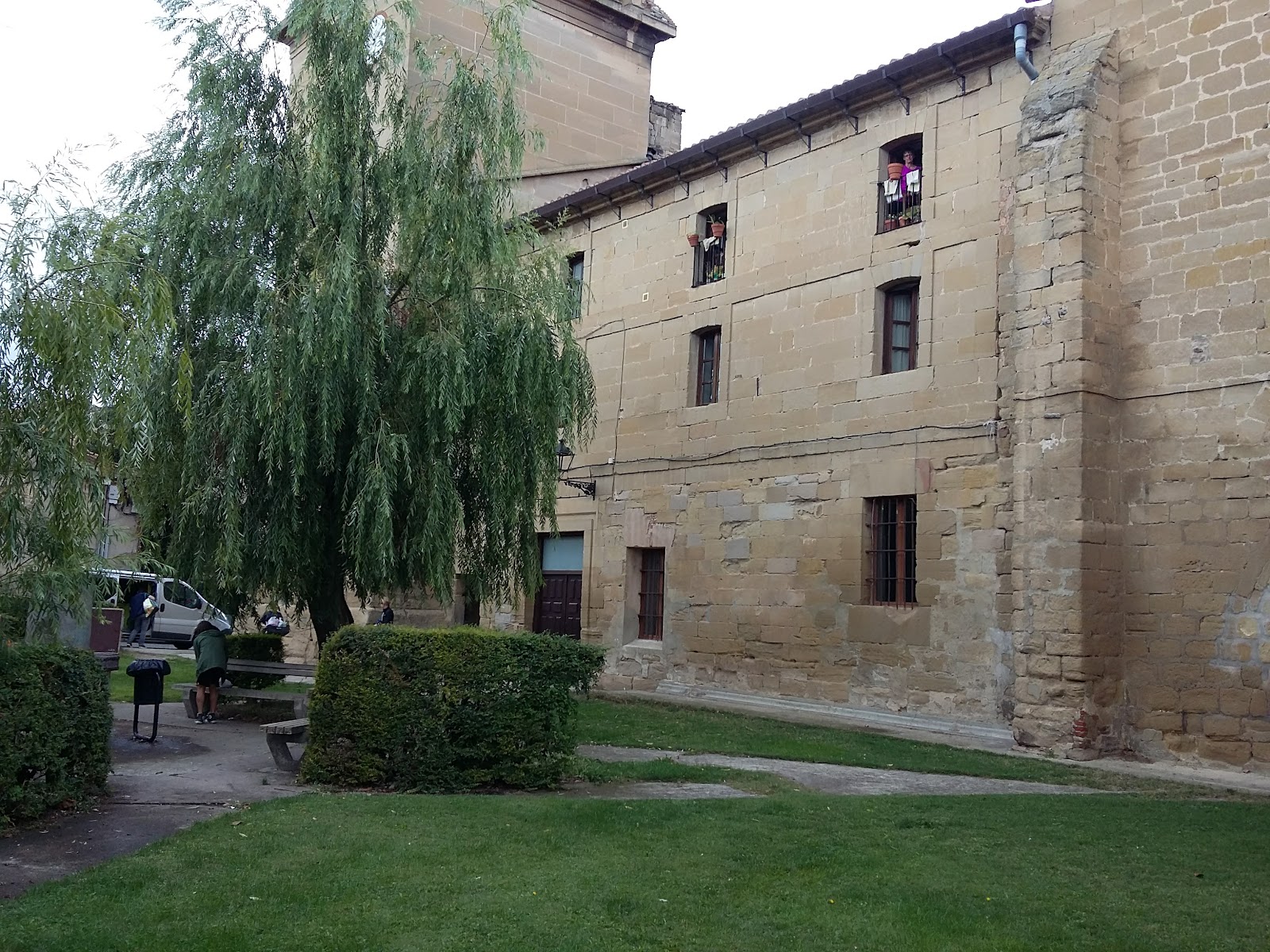
The San Juan Bautista albergue is very unique.  It is attached (literally) to the church and is a minimalist experience.  It is all stone and wood and very cool.  


We are sleeping in a loft on a 2½” pad on the floor with 10 other people.  


There were other rooms downstairs that had the sleeping pads.  A total of 48 people spent the night there.  There was one shower & toilet for the women and one shower & toilet for the men, plus one more toilet for all of us.  It was interesting.


Laundry room
There was a large room with tables to sit at and write, read or visit.  While I was writing in my journal, a young man was playing a guitar and it made it peaceful and relaxing while so many people were around.  The laundry room was at the top of the church!  There was a door in the loft that opened up into a room with a stone/concrete floor that must have been above part of the chapel.  There was a sink for hand washing and lines strung up for drying the clothes.  If it was a sunny day, there was a clothesline in an empty lot about a block away that pilgrims could use to dry their clothes.  Definitely one of the coolest laundry rooms I’ve ever seen.

Curtis was able to make himself valuable as a translator for the albergue volunteer that didn’t speak English.  The other volunteers were out and she was trying to help everyone check in and get settled. He even helped check people in when they arrived.  I hardly saw him all afternoon and early evening.  

At 6:00 pm, those who wanted to were able to help prepare the communal meal.  Mass was at 7:00 pm and dinner at 8:00 pm.   We attended the mass so we could enjoy the whole pilgrim experience and out of respect for our hosts.  At the end of the mass the priest had all of the pilgrims come in front of the altar and he gave us a special pilgrim blessing.  

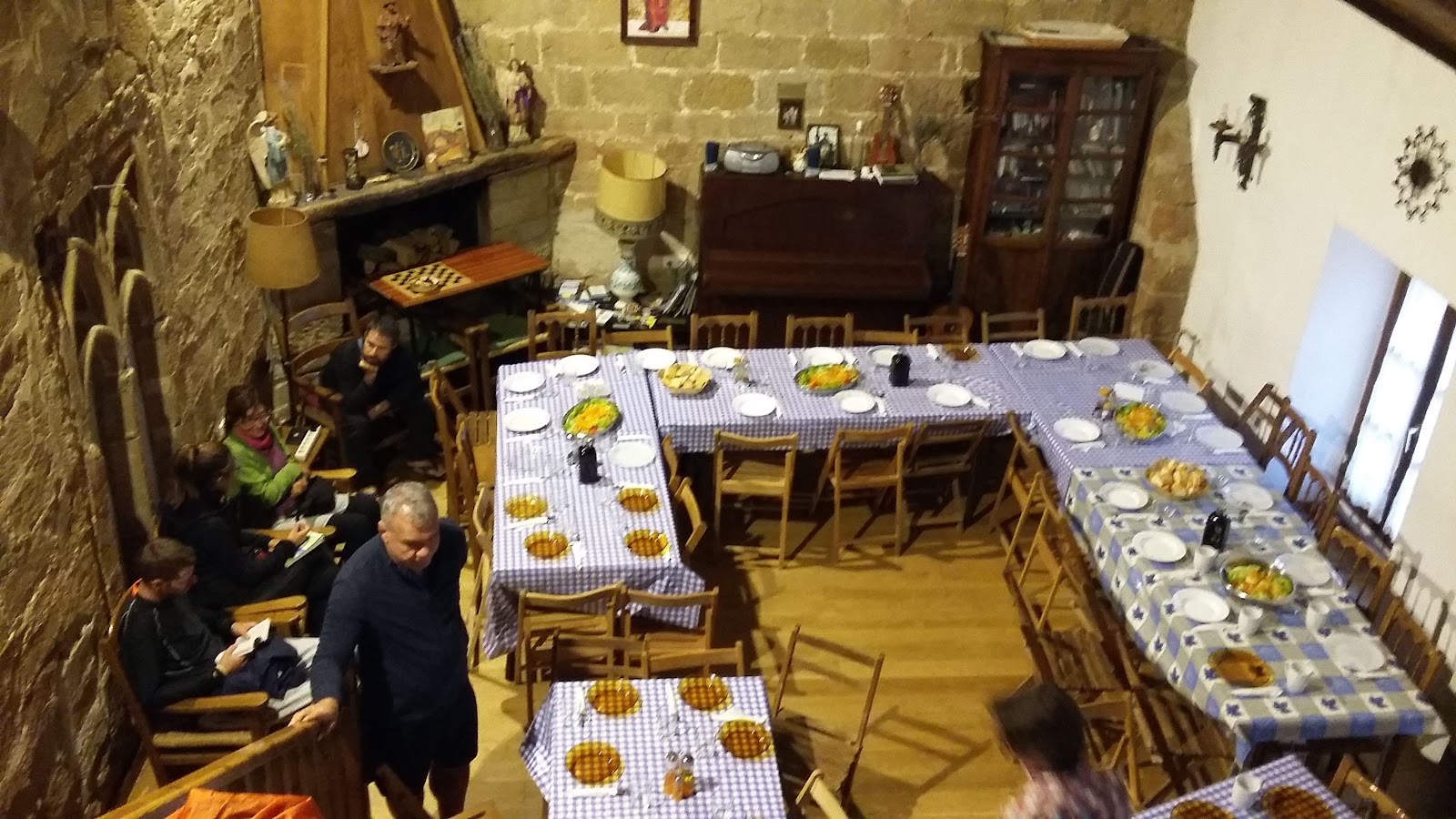
Dinner was very crowded with all 48 of us.  It was fun to see everyone talking and laughing.  Most of the pilgrims were Italians, but we some Swedes and Hungarians, too.  There were only 3 or 4 Americans.
Choir loft where we listened to some
beautiful guitar music and shared our
thoughts after dinner.

After dinner they took the pilgrims to the choir loft of the church.  One of the volunteers played the guitar and they had a single candle lit.  Everyone sat in the choir chairs or on the floor.  The host spoke in Spanish, Curtis translated what he said into English, and another pilgrim translated what Curtis said into Italian.  It was quite a process, but almost everyone should have been able to understand one of them!  They passed the candle around to everyone in the room and asked them to tell why they chose to come on the Camino, or share some kind of uplifting thought in words or music.  It was really very moving and reminded me a lot of the campfire testimony meetings at girl’s camp.  It created a loving atmosphere for those who attended.  Most of the albergues that we have stayed in do not go to that much effort to create a special bonding experience for the pilgrims. The volunteers feel a great love for the service they are giving and the pilgrims feel it! How they do it day after day, 7 days a week, I do not know, but they do!


20170909_141438.jpg
Michelle waves from the dinig room / lounge of the alberque San Juan Bautista, in Grañon
Curtis writes:
The day started out rainy. But the dry land surely needs it. It's still beautiful.
Like the day before, we spent the night in a small town and walked through the bigger towns without seeing much of the sites in that town. This is the bridge on the way out of Santo Domingo de la Calzada. I don't think this bridge is ancient, but it's certainly designed for a wetter era.
Bridge over the Rio Oja that flows down from Sierra de la Demanda and gives the region its name: Rioja

We spent the night in an albergue that is part of the cathedral in Grañon: Albergue San Juan Bautista.
It is a "donations only" place. Everybody pays what they can. There are no beds, only mats on the floor. But it is a very popular spot. There were more than 45 guests there that night. At 7:00pm all were invited to attend mass, and then at 8:00pm we had a communal dinner. By ‘communal’ it’s understood that everyone shares.  Only one big salad is made, one big pot of soup, etc. After that, there is singing and then lights out at 10:30pm.  When we got here, relatively early in the day, there were already 4 guests before us.  About the time we arrived, three of the four people in charge went shopping for the evening meal.  The remaining volunteer did not speak very much english, so she relied heavily on me to translate.


The instructions for the arriving guests were simple:
  1. 20170909_153028.jpgLeave your boots at the window as you come up the stairs, and your poles too.
  2. Sign in with first name, last name, nationality, where you started the Camino and where you started this morning.
  3. This is a donations only albergue; the collection box is there.
  4. There are 2 and a half baths.  Women’s bath on the left, men’s on the right and the half bath is off the stairs one floor down.
  5. The kitchen is not communal - only the hospitaleros will be working in there.
  6. The laundry is upstairs in the attic over the church.  If the clothesline in the attic is full, we have access to a clothesline in a lot across the square and around the corner.
  7. The password for wi-fi is shown there.
20170909_152510.jpg
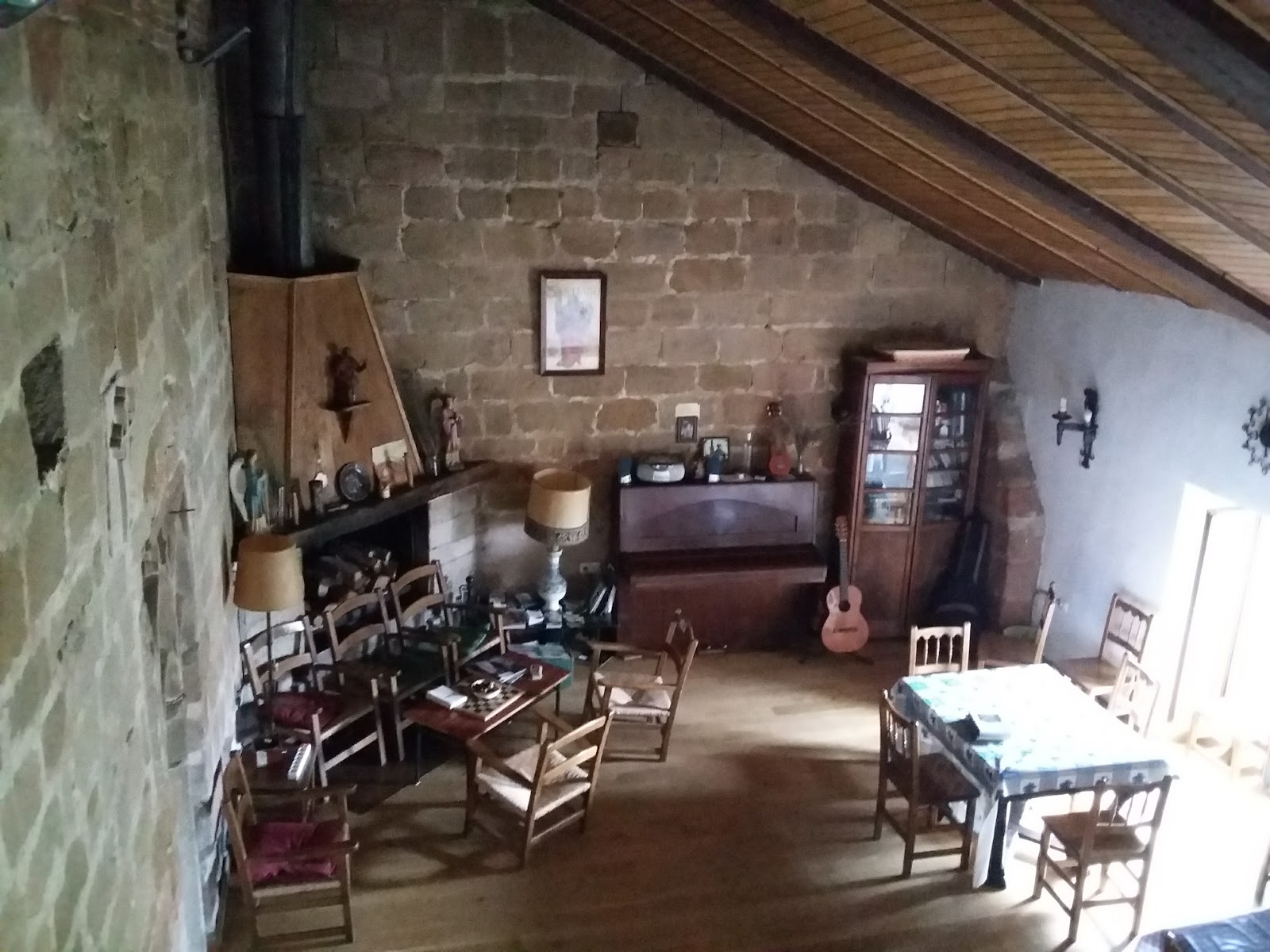
The picture above was taken early in the evening, showing the loft where we slept (in the far back corner), the kitchen and showers are below the loft, on the left of this picture and the reception is on the right. The view from the loft is shown below.
20170909_123148.jpg
View of the lounge area from the loft where we slept
IMG-20170909-WA0008.jpeg
Same view, but prepared for dinner

The view from our corner of the loft.
  • 22 of the guests were from Italy
  • 4 from USA
  • 3 from France
  • 3 from Sweden
  • 2 from Hungary (Alex and Erik, twins on bikes who had covered ground that day that took us 4 days)
And 1 from each of the following:
  • Mexico
  • Germany
  • Bulgaria
  • Brazil
  • Holland
  • Portugal
  • Denmark
  • Spain
  • Estonia
  • Latvia
  • New Zealand


Michelle signing the register at
Albergue San Juan Bautista in Grañon

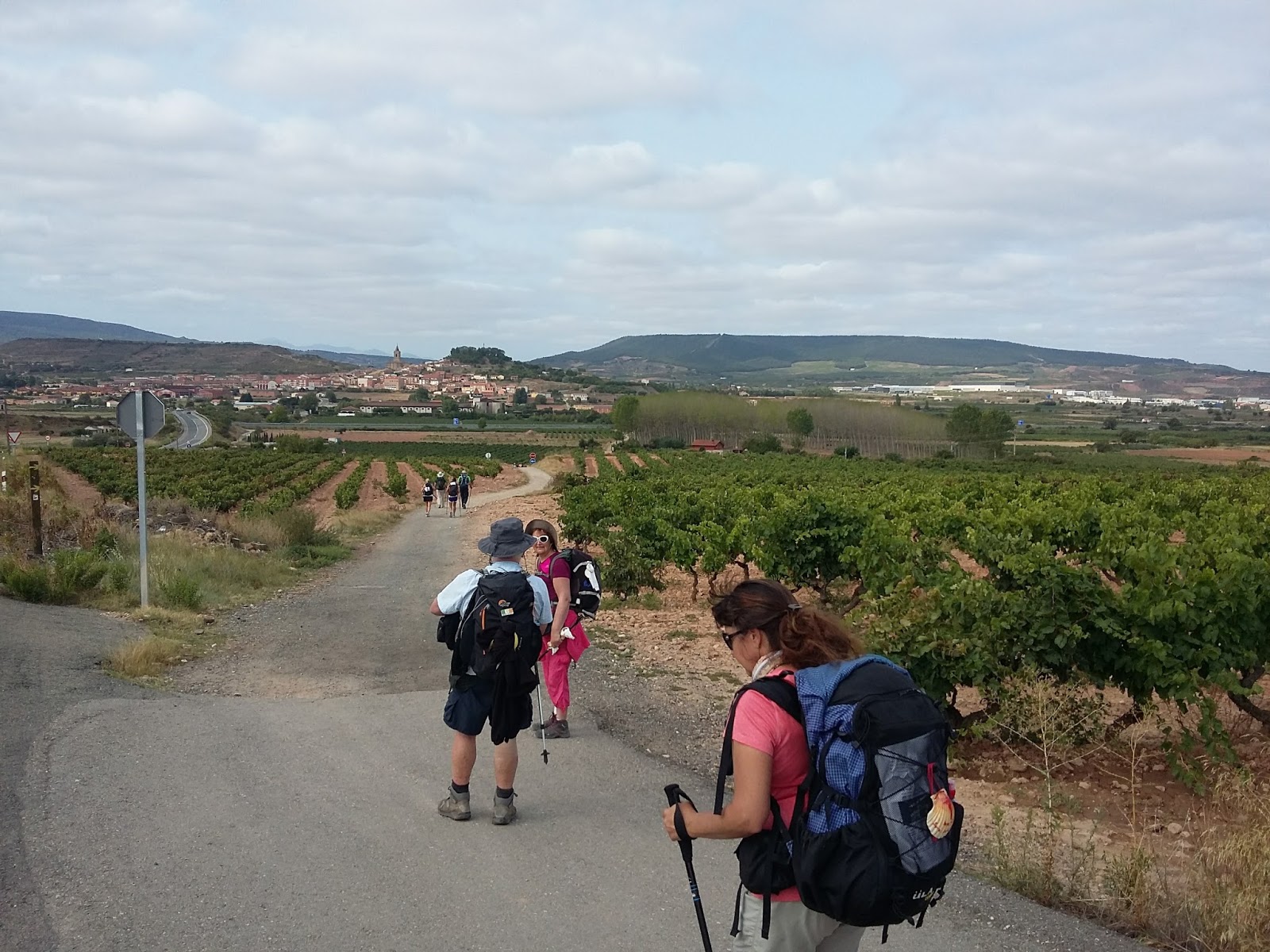
The approach to Grañon.  The trees at the end of the road in this image
shelter the water fountain in the image below.

Looking back at the road from Santo Domingo.
The grass, the bench, the water, the shade: great spot for a pilgrim on a hot day.
The walk from Santo Domingo to Grañon was unique in that we happened to be walking with a large group of kids walking with a few adults.  I assumed it was a school group, but Michelle pointed out that it was Saturday.  One of the adults towards the front of the group was telling some of the boys walking near him about legends in history.  I wanted to keep pace with them and listen too.  They were talking about Marathon when I first heard him.  But I also needed to keep pace with Michelle.  That girl sets a pace and just goes.  It's hard for her to stop and start.  So I had to leave the history lesson behind for awhile.  Eventually they caught up with us again and the professor was several centuries further along and still facinating to listen to.  I just realize that the effort to translate what he was saying made it difficult for Michelle, hence she walked on.

View of the Camind de Santiago as it leaves Grañon
Every evening on the Camino needs to include the activities necessary to be prepared for the next day.  In Ventosa, we learned to scout out the path leaving town while there's still light.

And on this particular day we had to make sure we knew where to catch the bus the next morning (Sunday) to get back to Logroño for Church.  We asked at the first bar, but the owners were new to the town and they did not have an answer.  Later, as we were walking from the park, we came across a lady watching people pass by from her upstairs window.  We asked her and got the answer we needed.  The bus does not go through the town.  There's a shelter just off the freeway where the bus will stop.

If you need a bus in the area of Logroño (between Burgo and Zaragoza), I recommend Autobuses Jimenez
We bought tickets online each time we rode the bus.  It turns out that is rare.  Most people pay the fare when they board.

Monday, October 23, 2017

El Camino de Santiago - 2017

Day 2: Ventosa to Cirueña

Michelle wrote in her journal:
08 Sept. Friday We were woken at 6:00 am by a recording of monks singing peaceful morning chants. We ate a quick bite and were out the door at 6:45 am. It was cool, peaceful and dark walking towards Najera 11 km away. We didn’t see much of the sunrise because it was behind us! We entered Najera through the industrial side of town, which wasn’t very scenic or interesting. We wound our way through the small city to the old part, near the cathedral, which was much interesting. The cathedral was built right under the bluffs of red clay. You could see “caves” that were cut out of the bluff. It was fascinating to see how close to the bluffs the buildings were. I’ve never seen that before. It was a bit hard to climb up and over the hill out of Najera, but we finally did and enjoyed the cool walk to Azofra, where we took a break for about an hour. From Azofra it was a gradual, steady climb to the kind of deserted village of Ciruena. Before we began the steepest part of the road, we found a rare spot of shade on the edge of a field and took a break, taking off our boots and socks to let our feet air out. Our feet were getting very sore and tired. It was getting pretty hot, too. Two Irish ladies joined us in the grass for a much needed rest. It was fun talking with them, a mother and daughter. I thought they looked pretty done in, but they kept going. I admired them for their determination. We began the long and tiring walk up the hill to Ciruena. There was a nice golf course on the left and we could see people playing golf. On the right and up ahead were modern apartment buildings that were empty and all for sale. It was kind of eerie to see so many nice buildings left vacant. It was a bit depressing to walk through that, but we were ready to drop by then and had to keep moving. We found our albergue, Albergue Victoria and there were 8 pilgrims in our room. I had a top bunk and found it awkward to pull my 57 year old body up the little ladder to get into bed. I must have looked pretty funny! My bunkmate was a woman from Seattle, Cathy Van Dyke. She was very nice and fun to talk to. The albergue was comfortable and the hospitalera worked hard to make us more comfortable. She did our laundry and let us use a little foot spa! The two Irish women finally made it to the albergue, but the albergue was already full. Curtis was very helpful in translating for them to help them find a place to stay in the next town, Santo Domingo and in getting a taxi to take them there. They were completely worn out. We had dinner downstairs with the other pilgrims and met people from Taiwan and Arizona. There were others, too, but they were too far away to talk with. Everyone was very friendly and once again Curtis was extremely helpful translating for people. We were able to use the albergue computer to purchase our bus tickets to take us back to Logroño for church on Sunday.
Although this is somewhat of a repeat, here is what I remember:

We left Ventosa in the dark.  But, the evening before, we took this picture showing the trail heading over the hills in the right of the image.

View from to top of the hill at Ventosa
After our first day on the trail, we felt relatively good.  Talking about plans for the next day, we decided that the 16.4km we had hiked from Logroño to Ventosa was not bad.
Our original plan was to hike about 15km to Azofra from Ventosa, but we decided we could probably be ok doing an additional 9km to Cirueña.   We used Booking.com to reserve 2 beds at alberque Victoria in Cirueña.

Bright and early we were on the road again.  In the dark, there was some concern that we would miss the signs.   The signs on the road through town were easy to see, but after 5 minutes walking, we were in the fields.  We didn't see any lights from hikers ahead of us (we knew others had left the albergue before us) and we could not see anyone coming behind.

Leaving Albergue
San Saturnino in Ventosa
At this point I would have been greatful to have the app called Camino Companion.  It can show where you are, and where the trail is on a Google Map satellite view.  I did not find out about this app until several weeks into the trip.  You can access it at:
http://atlasguides.com/camino-de-santiago/

One of the cool features of the app is that is shows how many miles from where you are to different keypoints on the trail, such as the next fountain, a view point, an albergue, etc.

Having the app would have saved us some anxiety as we were hiking along in the dark, but eventually we saw a headlamp coming behind us and renewed our confidence that we were on the right track.  It's interesting how we get used to "community" and when it's absent, we miss it.  I first became aware of this phenomena as a child living in Mexico City.  When we went for a picnic in the mountains surrounding the city, we would look for a peaceful secluded spot.  My mother pointed out that we were the anomaly.  Most other families out for a picnic would choose a spot within view of another group.  This leads to introspection on "group think" and the wisdom of "following the crowd".
To see what the terrain looks like, I really like Google Maps.  In fact, since we hiked this first section in the dark, we could not really tell what it looked like - until just now when I checked it out in Google.  In the image at the top of this blog page, you can see that the Camino goes up into the hills.  When we crested that hill, the huge valley beyond was mostly dark.  We paused for a moment to see the lights of the towns and villages spread all over that valley.  So, here is the link to where our morning picture was taken: In Ventosa
Approaching the town of Najera, we passed the Poyo de Roldan, site of a tremendous fight (according to legend) that took place in the 700's.  Roldan, the nephew of Charlamagne defeated the 9' Syrian giant Faragut after 2 days of one-on-one combat.


The walk into Najera took us through the industrial part of town, so we were not as charmed with it as we were when we left.  Nevertheless, that's the real Spain and that's what we wanted when we chose to skip the tour buses and get to know Spain on foot.  After passing the factories, we entered the residential section (read: apartment buildings), we passed a school on the first day of classes and stopped at the first open bar for breakfast.

Old town Najera is build between the river Najerilla and red clay cliffs of the bluffs west of town.  In fact we could see where rooms had been carved out of the cliffs with windows opening on the town.  The next time we pass through there, I think I would like to stay in Najera and see it in more detail.

The Camino passes in front of a monastery just before it leaves town through a break in the bluffs.  This was a much more pleasant transition than the entrance to town.  The climb was steep, and we could see mountain bike trails going further up into the hills, but we focused on the road ahead.  We had a long ways to go.

Looking back at Najera
Looking forward, away from Najera towards Azofra

From Najera, we had 5.7km to go before lunch at Azofra, and then another 9.2km uphill to Cirueña.

Screen shot from Gronze.com, the most useful tool for planning your Camino
We were fortunate that the weather was only hot, and not extremely hot.  A little more cloud cover would have been appreciated, but the heat is easier to tolerate than rain with wind.  So no complaints about the weather.

After passing through vineyards and potato fields, we came within site of Azofra.


The cool sounding name has Moorish roots referencing vassals.  In 1168 a hospital for pilgrims was built here.  There was also a cemetary specific for pilgrims.  Fortunately we did not need the services of either of these, having been served quite well at Restaurante Camino de Santiago Bar Sevilla where we had lunch under umbrellas adjacent the fountain.  Some of the people that I bunked with the night before caught up with us at Azofra.  They were taking an 'easy' day and had made reservations to stay the night in Azofra.  Our original plan was also to stay at Azofra.  As we were eating, we noticed people showing up, dressed for an event.  It turns out that this was the day the procession was held where they brought the image of Mary out of the church and paraded through town.  The manager of the restaurant came and moved the tables where we were eating so there would be room for the procession.  We waited to see it... and waited... and eventually gave up and hit the road.  Just as we were leaving town, we heard the band, but it was too late to go back.

Looking forward from Azofra, the road was long.  And it was hard.

The view towards Cirueña
The image above shows 2 roads going over the hill in the distance.  Ours is the one nearest the center.  If I remember right, there was a lonesome tree that provided a little shade along the road, and then several kilometers further on, another group of trees around a shallow pond.  That was it for shade.  We passed the tree and we almost passed the pond when I thought to myself : "We have reservations at the next albergue.  Why over do it?"  So, we backtracked a little to get across a ditch that surrounded the field, and walked a short distance through the field to the shade of the trees around the pond.  I pulled out the clothes that I had washed the evening before and spread them out on the stubble in the field to make sure the dried completely.  We took off our boots and massaged our feet with cream.  Eventually a mother-daughter team from Ireland came by and we invited them to join us.  They were hurting much more than we were.

Eventually we gathered enough energy to continue our trek.  As we neared the top of the hill, looking back we could see on the far horizon, the mountain we had climbed in the dark from Ventosa.

View back towards Azofra, Najera, Ventosa and Logroño from the hill approaching Cirueña
Once the hill was crested, there was a long flat section leading to the town.  Some of it was along a golf course (the only one we've seen from the Camino).  The green grass on the course was a sharp contrast to the dry fields everywhere else.  At this point on our hike we did not realize that a drought was aflicting that whole region.
Albergue Victoria

Cirueña is a very small village - in it's original state - but at some point there was an idea that it would be a great bedroom community for Najera and a lot of modern apartment buildings went up, along with the golf course and a sports club.  Unfortunately I think the economic troubles of the past few years interrupted that plan and there are For Sale signs all over these new apartment buildings.  Sad.

Our albergue is in a relatively new apartment building, near the edge of the old town.  The owner works very hard to accomodate all the guest she can fit.  We were the lasts ones to get a bed.  Michelle was surprised to see that her bunk mate was Cathy who we walked with coming out of Logroño.  She had come earlier in the day by taxi.
Sometime after we had showered and started the laundry, the Irish ladies arrived.  They were in bad condition - and there was no room in the inn.  The owner called a taxi, and while he was coming, they were able to call and reserve a place in the next town, Santo Domingo.

We had hiked too far.  Despite being physically able to do it, the stress on our bodies was not worth it.  We should have stayed with our original plan.  Fortunately the next day is a shorter hike.


Sunday, October 8, 2017

El Camino de Santiago - 2017

Prolog

At the end of our flight from Spain, as we were walking from the plane to retrieve our luggage, I checked my phone for messages sent while the device was in airplane mode.  There was an email informing me of the passing of Wanda Rogers.  What a bitter-sweet ending to our adventure on El Camino de Santiago.  Wanda and her husband, Carl, were very tightly linked.  Carl passed away this spring.  As we were flying home to Atlanta, Wanda was flying home to Carl.  

It's partly Carls' fault that we have been hiking El Camino now.  Several years ago, I visited Israel and brought back an olive branch and a bottle of olive oil for Carl.  He had them framed in a shadow box and placed on the wall.  He always wanted to visit the Holy Land, and as soon as his health improved, he and Wanda would go.  Time went by and his health did not improve.  I wondered if he really would make it to Jerusalem.  Then I began to go through health issues myself: appendicitis, a bulging disk in the lower back, etc.  For years, I had been interested in hiking El Camino de Santiago and I kept putting it off for one reason or another.  As I became aware that Carl's declining health would probably prevent him from ever visiting the Holy Land, I realized that I could easily be in the same kind of situation with my own health, and that I should go sooner than later.

I have spent many hours with the Rogers over the years.  Ostensibly I was a 'minister' to them, a "Home Teacher" in Mormon terminology.  But the blessing was mine to learn from them and their long history.  Besides being a father, Carl filled two very important roles in his life: first as a defender of freedom in the Korean war and the second as a teacher.  His philosophy seemed aligned with Mark Twain who is quoted as saying: "Travel is fatal to prejudice, bigotry, and narrow-mindedness".  Carl and Wanda loved to travel. I feel like the final lesson I learned from them was to not put off a learning opportunity such as hiking El Camino de Santiago.

So, about two years ago I started planning my trip.  Generally Michelle does not accompany me when I go hiking.  But as the plan began to take form, she realized there would be no sleeping on the ground.  There would be no cooking over a campfire.  Warm showers would be available every day and a bed every night, and there would be good Spanish food.  Well, "Why should Curtis go to Spain alone?"  She made up her mind to come with me.

In September of 2016 we hiked from St. Jean Pied du Port in France, over the Pyrenees and through Navarra, Spain to Logroño, on the edge inside the province of La Rioja.  We covered 100 miles in 10 days.

Entrance to Logroño: the Puente de Piedra (Bridge of Stone) over the Rio Ebro
After hiking 100 miles, oh what a joyful site it was to see this bridge, the end of the 2016 section.
The adventures of that hike are described elsewhere.  This narrative is about El Camino in 2017.

Day 0: Atlanta to Logroño 

Going there and Going Back Again

On September 5th we left Atlanta and flew overnight to Madrid, arriving in the morning.  We each carried a back pack on the plane and we checked in a suitcase with clothes that we would use at the end of the trip and gifts for our hosts in Logroño and A Coruña.  The suitcase also contained our collapsible hiking poles and other things that cause problems with security in some airports.  Once in Madrid, we moved things out of the suitcase that we would need during the hike and then sent it to our friends, Fuco and Idoia, in A Coruña via the mail: Correos.

From Michelles' perspective:
05 Sept.   Tuesday
My friend Nora drove Curtis and I to the airport.  We checked the yellow suitcase that had gifts and our boots and poles.  While we were waiting at our gate we ran into Marta Tellez and her son Michael Turner!  We met Marta shortly after we moved to Suwanee and watched her two boys (Christian and Michael) grow up into fine young men.  They were also going to Madrid and will drive all around Spain with some friends they are meeting in Madrid.  It was great to start the trip in such a fun way!  Our Delta (KLM) flight left at 5:55 pm and was an uneventful direct flight to Madrid.  We both got a little bit of sleep on the plane.  As usual, I can’t sleep on a plane.
If you've spent much time in the Barajas Airport, in
Madrid, you've probably come across this gentleman.

To get to Logroño we had the option of taking the train or the bus.  Both leave right from the airport.  The train left shortly after the flight arrived.  The bus left 4 or 5 hours later. We did not know how long it would take to get through customs, so from the U.S. we had bought bus tickets on the ALSA bus line.  The fortunate thing about that decision is that Correos, the Spanish Postal service had a system-wide crash and they could not process our suitcase when we first tried.  If we were going on the train, we would have had to take the suitcase with us to Logroño, and delayed hiking the next day until after Correos opened.  As it was, several hours later after we had a nice relaxing lunch in one of the nicer (read expensive) airport restaurants, Correos was able to process the suitcase and we were able to stick to the plan.

For future reference, HERE is the web site of the lounge in the Madrid airport where we could have taken a refreshing shower and a nap before traveling on to Logroño.

Our seats on the bus were the front two, which was great for taking pictures of the countryside between Madrid and Logroño.  This image shows the approach to Sierra de Cebollera that forms the border between the regions of Castilla y Leon (Madrid) and La Rioja (Logroño).

Approaching Almarza and the foothills of Sierra de Cebollera
(This text in orange is intended to be a link to Google Maps where the picture was taken.)
Later on in this trip we will again transition from the 
plains of Castilla y Leon to the mountains but not near as fast.
In the Sierra de Cebollera
As we got to the top of these mountains it was interesting to see there are poles along the road to guide snowplows.  I don't associate central Spain with snow.  I learned something new.

At one point I started taking video and promptly learned something else new from the bus driver:  Pictures OK, Video NO.  Well, alright, but it would have been fun to show the manuevers of the big bus on the narrow mountain roads.


The splotches on the wind shield are not a problem in the Google Maps image of the approach to
Torrecilla en Cameros
Michelle writes:
06 Sept.    Wednesday
We arrived in Madrid at 8:15 am.  We found the correos (post office) in the airport and tried to mail the yellow suitcase to Fuco in A Coruña, but their system was down.  They told us to come back later.  We then found an electronics store in the airport where Curtis was able to buy a SIM card and get his phone set up to work in Spain.  That was a huge a relief.  (We felt handicapped last year when we had to wait until we got to Pamplona to get his phone working.)  We ate lunch at a nice quiet restaurant, then went back to the correos and were finally successful in mailing the suitcase.  Another relief because we did not want to be dragging that suitcase along with our packs to Logroño!
We found where we were to wait for our bus to Logroño and then sat and read or slept until it came at 3:15 pm.  The transportation system in Spain is very organized and on time.  You only have 5 – 10 minutes to get on or you will miss your bus!
We took the Alsa Premium bus to Logroño.  What a nice bus!  It was much more comfortable than the airplane.  Wider seats, more leg room.  They even gave us a snack!  We sat in the front 2 seats and had a great view out the big front window.  It was a 4 hour reide and it went through some beautiful contry – especially going over the mountains.  The highways we drove on were the E90/A2 to Soria and the N111 into Logroño.


We arrived right on time at 7:15 pm.  Mailu and her son Jorge met us at the bus station.  
Bus station in Logroño
(picture taken by Mailu while waiting for us to arrive)
I must interrupt Michelle here and explain a little about Mailu.  We fell in love with Logroño last year, mostly because of new friends Mailu and Javier, and Asun.  We worshiped with them on Sunday at the end of our trek last year.  Then we were invited to stay the night with Javier and Mailu - and the next, and enjoy the festival being celebrated in Logroño that week.
Kevin Pack, another new friend that we would meet later on the Camino wrote about these kinds of friendships this way: 
"I met a man named Curtis Whetten from Georgia who was walking the Camino De Santiago with his wife. As we spoke, we discovered that we had many friends in common back in Georgia. It made me think about one of the great blessings of being a member of the Church of Jesus Christ. Because of my membership in the Church, I have friends literally throughout the world, wherever I go. Paul's words to the Ephesians indeed rang true to me that day...."Now therefore ye are no more strangers and foreigners, but fellow citizens with the saints, and of the household of God; And are built upon the foundation of the apostles and prophets, Jesus Christ himself being the chief corner stone." (Ephesians 2:19-20)
I am grateful to belong to The Church of Jesus Christ, built upon a foundation of apostles and prophets, with Christ himself as the chief cornerstone."

As I ponder his words and think about worshipping in Japan, South Korea, the Philippines, Singapore and Malaysia I must agree.  I made instant friends in all of those places.

Michelle continues:
They took us to our hotel and then we walked downtown until we could eat dinner – the restaurant Mailu recommended didn't serve dinner until 9 pm.  We ate food that is typical of the La Rioja region.  I had a thin steak and Curtis had halibut.  Then they drove us by their new church building and dropped us off at our hotel, the NH Hotel.  That was a very nice hotel and we slept really well – we were so tired.

Well, it's a good thing Michelle kept a journal because I totally forgot to mention the sim card for the phone.  That was crucial for making arrangements for places to stay, for arranging transportation, for keeping track of where we were, for emergencies (none occurred), etc.  Last year we used Vodafone.  This year we used Orange.  There were other lesser-known plans being sold at the airport.  I'm glad we passed on the first opportunities because they were way over-priced.  As it was, had we gone into Madrid, we could have found a less expensive plan but I did not want the trouble.


Day 1: Logroño to Ventosa

Michelle writes:
07 Sept.  Thursday
On the road again...
First of 23 morning shots
(Hotel NH in the background)
We slept until 8:00 am, ate breakfast at 9:00 am and started walking at 9:45 am.  We walked trough a beautiful park (Deportivo) that is big and very popular with walkers and bikers.  We stopped for a short rest at a park by a little lake.  There were lots of other pilgrims with us.  We took a break and had a snack in Navarrete.  Navarrete is a nice town with a cathedral that looks pretty normal on the outside, but was very beautiful and ornate on the inside – lots of bright shiny gold.
The Camino took us through more vineyards and olive groves.  There were very few hills.  We stopped for the day in Ventosa at the Albergue San Saturnino.  It is a very nice place and most of our fellow pilgrims are from Germany or Italy.  There were only 4 of us here that spoke English: an Irish woman, an American woman and Curtis and I.

My bunkmate was a woman from Italy, Laura.  There was only one other woman in our room.  The rest were men, 4 or 5 of them.  One of them was an amazing snorer.  He could snore in any position he slept in, and loudly!  Curtis was in a different room and had his own set of really good snorers!  I didn’t get a lot of sleep that night!  We ate dinner and then walked around this nice little town.  We walked up to the cathedral and got some nice pictures.  (It seems that the churches are almost always at the top of a hill.)

"This is like a walk in the park..." literally

Water is readily available in every village along the trail.


Michelle tells the story much faster than I can keep up with the pictures, so here is what she was writing about:
Just outside of Logroño we meet Cathy for the first time.
As the Camino leaves town, it passes through beautiful vineyards - and the grapes are ripe.


We meet lots of people every day.  Most we never see again - because most people hike faster than we do.  On this first day, we met Cathy from Seattle.  She walks slower than we do because of knee problems.  We slowed down to walk with her for awhile because we have things in common that we enjoy talking about.  Eventually she says something to the effect of "go on ahead, I'll catch you later" which could be a sweet way of saying: "you're walking too fast for me; don't let me slow you down."  I know because I've said that to other faster walkers.  I did not expect to see Cathy again.


Location on Google Maps
This is one last look back at Logroño before going over the hill
Over the hill from Logroño is Navarrete, a charming little town built on a hill.
Navarrete in the distance
These hikers are passing us.  They started earlier in the morning than we did, from a town on the other side of Logroño.
Narrow lanes are normal in the old part of town.
Modern development has left this side of Navarrete relatively untouched, perhaps because the big city is so close. Consequently we get to see the stone buildings and cobbled streets as they've been for many years.  At the plaza across from the church we found a pub and stopped to rest and for 2nd breakfast... or maybe it was Elevensies.


On a hot day, fountains like this were very refreshing


This is the little plaza adjacent the church where we ate.  It's interesting how prolific the stonework is in these old villages.  I am used to asphalt streets, concrete sidewalks or brick pavers and grass.

Naturally, I like the look of green grass... but where that's not feasible, this kind of stonework keeps it interesting.
Some towns are nicer to pilgrims than others.  Navarrete is particularly nice as is evidenced by these markers placed in the roadway close enough to each other for the pilgrem to easily find his way through town.
We never tried any of these grapes, although they looked tempting.   Last year I saw one pilgrim eating grapes, like these, right off the vine.  On this trip I did not notice any pilgrims taking any food from the adjacent fields.

Young Spanish Olives


It's not too clear in this picture, but with a little imagination you can see a town on a rise beyond the fields, but in front of the mountain.  At this point we thought that was our destination, Ventosa.  But, no... that is Sotés, and our town is more to the right.  I particularly enjoy using Google Maps to see the view from above in Satellite mode.  To see this exact spot in Google Maps, click HERE - Take me there!
Did you go there?  Did you drag the little yellow man-shaped icon onto the road to see the street view?  Did you advance down the road until you saw the next yellow arrow indicating the road to Santiago?
Nearly all of my pictures have the coordinates embedded in the metadata of the file, so if you ever want me to tell you where the picture was taken from, just let me know.
Ventosa, with the church on top of the  hill, can be seen on the right side of this image.
Curtis waiving from the entrance to Albergue San Saturnino
We were the last guest to be received at Albergue San Saturnino - I think - because we got assigned to adjacent rooms that each only had one bed to be filled.  My bunk room was filled with a group of friends that had accumulated over days on the trail.  One was from the US, one from Italy, one from Holland, a couple from Germany, and a lady from Belgium.  'Camino Families' come together over shared bunk rooms, then shared meals and shared sections of trail.  It's understood that everyone hikes their own camino, so if you want to go slower or faster than your friends in the group, that's ok.  If you are slow, you can expect to meet new friends coming behind you.  If you are fast, you can look forward to meeting new friends ahead.  Loyalty to your 'camino family' is not expected.

Now let me tell you a little about the albergue.  It seems to be run by a religious order in the Catholic Church.  I appreciated the sense of decorum with which they did things.  A couple of examples are: in the morning we were woken by a soft recording of Gregorian chants; the reading material in the lounge was spiritually uplifting; the guests were treated as pilgrims, not tourists.  

A good albergue has small bunk rooms (not 20 people in one room) and a decent ratio of laundry facilities and bathroom facilities per number of bunks.  At San Saturnino, the bathrooms for the men were on one floor and the women on another.  The mens room consisted of a row of 3 shower stalls opposite a row of three toilet stalls, and then at the end of the corridor formed by these rows of stalls was a section of sinks and mirrors.  The toilet stalls had short doors.  The shower stalls had 2 sets of curtains that allowed for a space to undress or dress in clean clothes without getting wet.  The most frustrating thing about most of the showers at the albergues is there are no shelves to hold your body soap, shampoo, conditioner, facial soap, etc.  Having experienced this problem last year, I found a solution for this trip.  At LL Bean I came across some rubber coated wires that I could form into an S-shape.  One end holds a net-bag with my cleansers, and the other is shaped to hang over the curtain rod or the piping to the valves.
The laundry at San Saturnino was a little overwhelmed and the clothes lines too short.  We were fortunate to get our clothes dry before going to bed.  Well, maybe the wool socks weren't completely dry.  We took no cotton so that our clothes would dry quickly.

One last good point about this albergue: the bunks were solid wood, not metal, thus much quieter.

After checking in, showering and doing the laundry, it was time to eat.  "Ensalada Mixta" (salad) was my most common 1st entre of the evening meal, and sometimes the only entre.  Every such salad has lettuce and tomato and albacore (like tuna), with a garnish of olive oil and vinegar.  From that common core all the salads had additional ingredients that varied.  Most often there were 2 or 3 long spears of pickled asparagus, olives, shredded carrots, sometimes kernals of corn, sometimes shredded pickled beats, sometimes cheese, often a sliced boiled egg.  And, of course, with every meal there is wonderful healthy bread.

After dinner, we walked around the town.  We went to the church at the top of the hill and were suprised with the peacefulness there and the view.
Michelle at the pilgrim fountain adjacent Iglesia San Saturnino
This peaceful setting was not to be wasted: at least one pilgrim slept in a tent on a flat section of this lawn.

This picture was taken on the patio at the entrance to the Church.

As we contiued to explore the little town we came across an excellent view of the Church.  I ran back and waved from the patio above.  Can you see me by the corner of the Church in the image below?


How interesting that we WALK around the town to relax after dinner.  As you can see in the image, the shadows are gettting long.  By the time we made it back to our rooms, there were people trying to sleep.  Thus ended our first day of the second section of the Camino de Santiago.
Select "Newer Post" below to read about what happened the next day.

Saturday, June 3, 2017

I'm cleaning up my desktop (the real physical one) and came across this printed article that resonates with me relative to too much news.  For me, too much news makes me depressed.  I recommend the article to you:
New is bad, by Rolf Dobelli